China switches on its largest standalone battery storage project

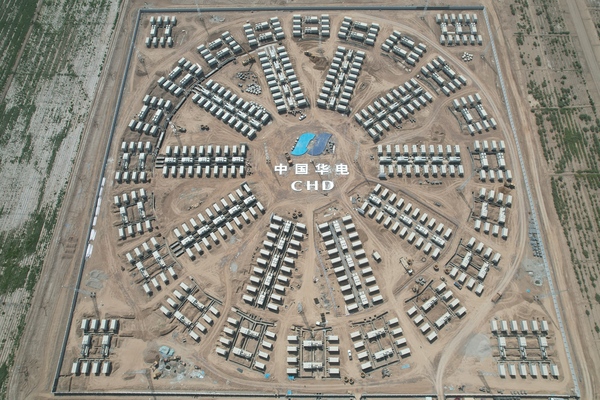
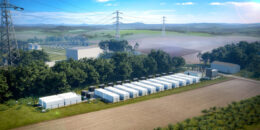
The first phase of the Huadian Xinjiang Kashgar, China’s largest standalone battery energy storage project, was commissioned on July 19. The 500 MW/ 2 GWh plant represents the first phase of the mega-project which is envisaged to double its size to 1 GW/4 GWh.
Located 41 kilometers east of Kashgar City in Xinjiang, the project spans 119,000 square meters and represents a total investment of approximately CNY 1.6 billion (around USD 222.9 million).
The facility comprises 100 lithium iron phosphate (LFP) energy storage units. It employs an innovative split approach, with half the systems utilizing grid-forming inverters and the other half operating with grid-following inverters. The plant is connected to the Kashgar 750 kV substation via a 220 kV transmission line, ensuring integration into the regional grid.
Huadian Xinjiang Company, a regional subsidiary of China Huadian Corporation — one of China’s five largest state-owned power generation enterprises — developed the project and will own and operate it. Supported by State Grid Xinjiang Electric Power Company and multiple construction partners, including PowerChina as the EPC contractor, the team navigated delays and logistical challenges to deliver this landmark project.
China continues to break new ground in energy storage deployment, both in scale and technology. For instance, last November, the first phase of the 500 MW/2 GWh Xinhua Wushi project, featuring a hybrid of grid-forming lithium iron phosphate and vanadium flow batteries, was commissioned. This project is the largest hybrid energy storage installation in China and hosts the world’s largest grid-forming vanadium redox flow battery, set to reach a 250 MWh/1 GWh capacity in the project’s second phase.
Most recently, construction began on a 1 GW/6 GWh battery storage facility in Ulanqab, Inner Mongolia. Owned by state-owned infrastructure giant PowerChina, this project is touted as the world’s largest power generation-side electrochemical energy storage system- meaning it is co-located directly with power generation assets to optimize grid performance.
Written by




Popular Posts